Why Uncertainty Feels So Uncomfortable for High-Functioning Professionals
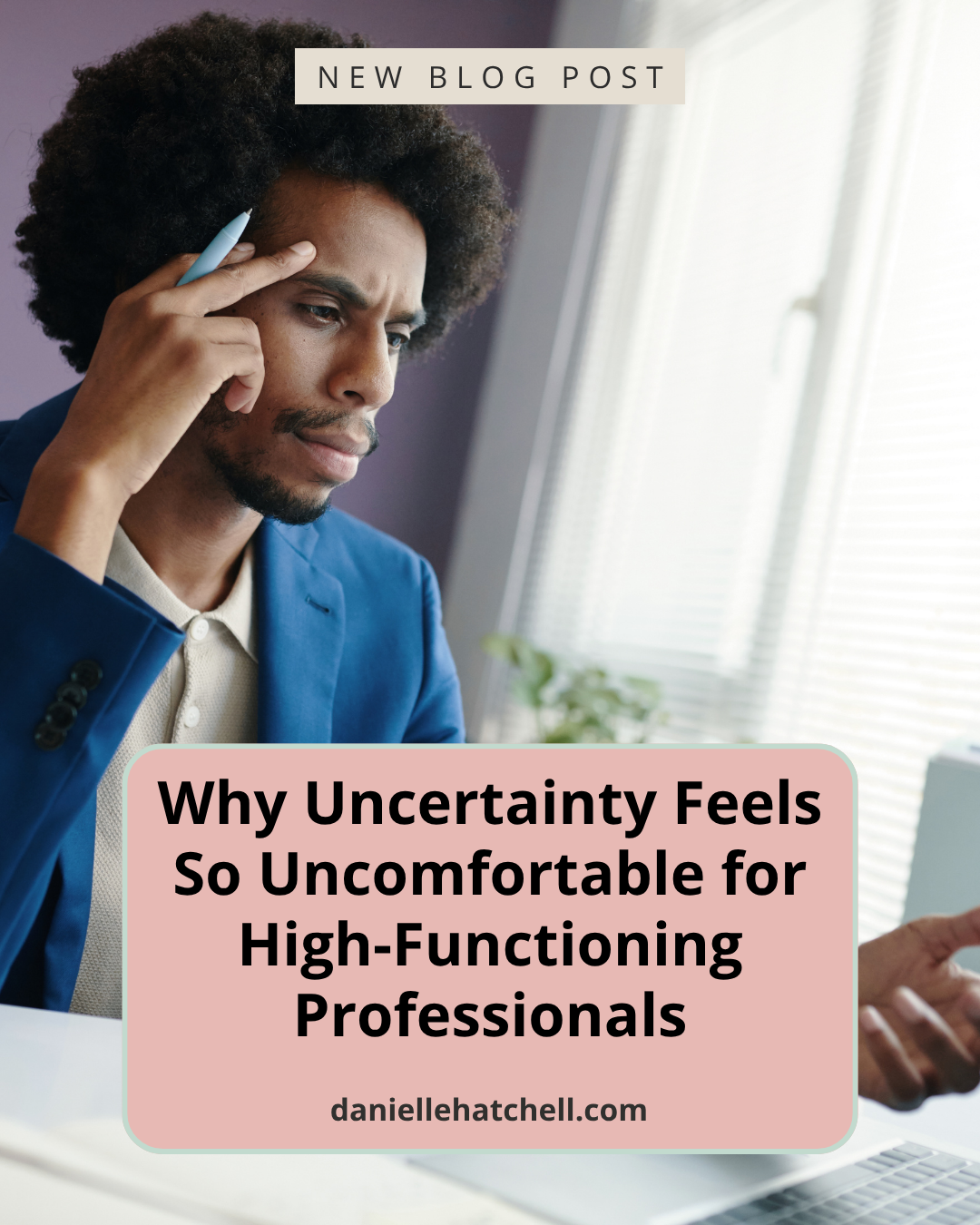
If I had a dime for every time a client has asked me, "How do I know if I'm making the right decision?" I’d be rich. This question usually comes up when they’re facing a crossroads in their life, and they're contemplating a major decision.
They may be thinking about accepting a new job or wondering whether to retire. The same uncertainty shows up when they’re trying to decide whether it's time to end a relationship, move closer to family, or start a business they've dreamed about for years.
Initially, it sounds like they're asking me to support them in making a decision, but when it boils down to the real issue, they want to know how to be certain they're making the right decision.
In reality, life seldom gives us a sense of certainty, especially during major life transitions.
If you've read my previous blogs, Life Transitions and Anxiety: A Guide for High-Functioning Professionals in Maryland, Anxiety During a Job Change Isn't a Sign You're Making the Wrong Decision, or Empty Nest Anxiety for High-Functioning Parents, you've probably noticed a common thread.
Every major life transition comes with a degree of trepidation and uncertainty, and uncertainty can make even the most capable people feel anxious.
High-Functioning Professionals Don't Like Uncertainty
One thing I've noticed after more than 25 years of working with high-functioning professionals is that they genuinely believe there is a perfect decision waiting to be discovered if they just think long enough.
I've watched clients stay up late at night creating spreadsheets to compare two job offers. They've listed salaries, retirement benefits, commute times, vacation days, opportunities for advancement, and every possible pro and con they could think of.
After spending hours analyzing the decision, they look at me and ask, "Which one would you choose?"
The truth is that both jobs are often good opportunities.
The feeling of anxiety isn't coming from making a bad decision. It’s coming from accepting that neither choice comes with a guarantee.
I've seen this same pattern with parents deciding whether to support an adult child financially, professionals wondering if it's time to switch careers, and couples debating whether it’s time to start a family.
Each situation is unique and complex, but the underlying pattern is the same.
Why Your Brain Wants Certainty
One of my clients recently accepted a promotion she had worked years to earn.
She had a tough time celebrating the win because she spent the first month rethinking every meeting and, on the drive home, second-guessing her professionalism and instincts.
She chastised herself for tripping over a word in the interview process. Then she wondered if she talked too much in meetings or didn’t speak up enough. Her brain ran through every interaction with her colleagues, and in each scenario, found her guilty.
And all the while, nothing bad had actually happened. Her boss was happy with her work, and her colleagues liked and valued her.
But her brain was trying to predict every possible outcome because uncertainty seemed uncomfortable.
Our brains naturally look for patterns that help us predict what's coming next. When we don't know what to expect, anxiety often steps in and convinces us that more mental processing and decision-making will make us feel safer, even when no problem exists in our current reality. Unfortunately, that's rarely how it works.
Overthinking Feels Productive
The fact that overthinking feels productive is one of the reasons anxiety can be so difficult to recognize. So many high-functioning professionals mistake overthinking for being responsible.
One client laughed and said to me, "I've asked my husband, my sister, my best friend, my coworker, and even ChatGPT what they think I should do." Then she stopped talking and smiled because she recognized that deep down, she knew what to do. She was simply overthinking her choices because she was looking for a guarantee that she was making the right decision.
That's an important distinction because consulting with others can help you make a thoughtful decision, but it cannot promise that you'll never question it.
Recently, my daughter spent three evenings researching whether she should accept a new job offer she received. By the time she came to talk to me about it, she had watched countless YouTube videos, listened to several podcasts, and read article after article about commuting to work.
She looked exhausted.
I finally asked, "What information are you still hoping to find?" She laughed. "There probably isn't any."
Exactly.
Trying to Eliminate Uncertainty Is Exhausting
I've watched clients spend entire weekends researching decisions they've already made.
They accepted the new job, but they continued looking at job postings just to make sure they hadn't missed a better opportunity.
They bought the house, but they checked real estate listings every night to see if something better became available.
They dropped their child off at college, then found themselves checking their phone every fifteen minutes waiting for a text message that simply said, "I'm okay."
Notice what all of those examples have in common.
The decision had been made, and the transition had already happened, but anxiety simply refused to let the experience be complete. Instead, it kept searching for reassurance that everything would work out exactly as planned.
The Search for the Perfect Decision
One of the things I've learned over the years is that anxiety convinces us there is one perfect choice, and if we could just find it, we'd stop feeling anxious.
Life doesn't usually work that way, and the most meaningful decisions involve trade-offs.
The new job may offer more flexibility, but you'll miss the coworkers you loved.
Your child may thrive in college, but you'll miss hearing them walk through the front door every afternoon.
Retirement may create more freedom, but it also asks you to reassess how you spend your time and where you find purpose.
Those aren't signs you've made the wrong decision. They’re actually reminders that every new phase of life asks us to let go of something familiar. And that can be scary.
Learning to Trust Yourself
One of the biggest shifts I help clients make is recognizing that peace doesn't come from knowing all the answers. You start to find peace when you trust yourself to handle whatever life brings.
I sometimes ask clients to think about the challenges they've already lived through. They share times when they changed careers, became a parent, or lost someone they loved. Maybe the change involved supporting aging parents, or living through a difficult diagnosis.
At the time, each of those experiences felt uncertain, and there was no guarantee everything would work out.
Yet somehow they found their way because they learned they were capable of handling hard things, and they even became stronger and understood themselves better through the process.
That's how you develop self-trust.
A Small Exercise I Recommend
The next time you notice yourself rethinking the same decision over and over again, pause for a moment and ask yourself one powerful question.
"Am I trying to make a thoughtful decision, or am I trying to eliminate uncertainty?"
That question can bring a much-needed shift in perspective.
If you're still gathering meaningful information, keep going.
If you've already gathered the information and you're simply hoping to feel 100 percent certain, your anxiety has probably taken over the conversation.
At that point, the work is no longer making a better decision.
The real work is in learning to tolerate not knowing exactly how everything will unfold.
Therapy Helps You Build Confidence
Many people come to therapy hoping I'll tell them what decision to make.
That's understandable because when anxiety is taking over, having someone else make the decision sounds incredibly appealing.
However, my role isn't to decide for you. It is to support you in better understanding yourself so that you can make a decision you can trust.
Together, we recognize the patterns that keep anxiety going. We identify when thoughtful problem-solving has turned into endless reassurance-seeking. We also develop practical tools that help you trust yourself rather than chase certainty.
One of my favorite moments in therapy is watching someone realize they don't need to know every answer or have a guarantee before taking the next step.
This is always a sign of increased self-acceptance and self-trust.
Anxiety Therapy Maryland
If uncertainty has been keeping you up in the middle of the night, you're not alone.
Whether you're facing a career change, adjusting to the empty nest, making an important relationship decision, or simply finding yourself caught in endless overthinking, anxiety therapy can help.
Through Anxiety Therapy Maryland, I work with high-functioning professionals who want to better understand their anxiety, strengthen their self-trust, and move through life's changes with greater certainty and clarity.
If you haven't already, I also invite you to read my pillar article, Life Transitions and Anxiety: A Guide for High-Functioning Professionals in Maryland, along with my articles Anxiety During a Job Change Isn't a Sign You're Making the Wrong Decision and Empty Nest Anxiety for High-Functioning Parents. Together, they explore how uncertainty sits at the heart of many of life's biggest transitions and why learning to respond differently to it can change the way you experience anxiety.
About the Author
Danielle Hatchell, LCPC, is a therapist with over 25 years of experience providing anxiety therapy in Maryland to high-functioning, anxious professionals. Her work supports individuals who are used to showing up for others but are ready to feel more grounded within themselves.
Her approach fuses traditional talk therapy with mindfulness, breathwork, and nervous system awareness, helping clients build practical tools and reconnect with a deeper experience of clarity and balance.
